
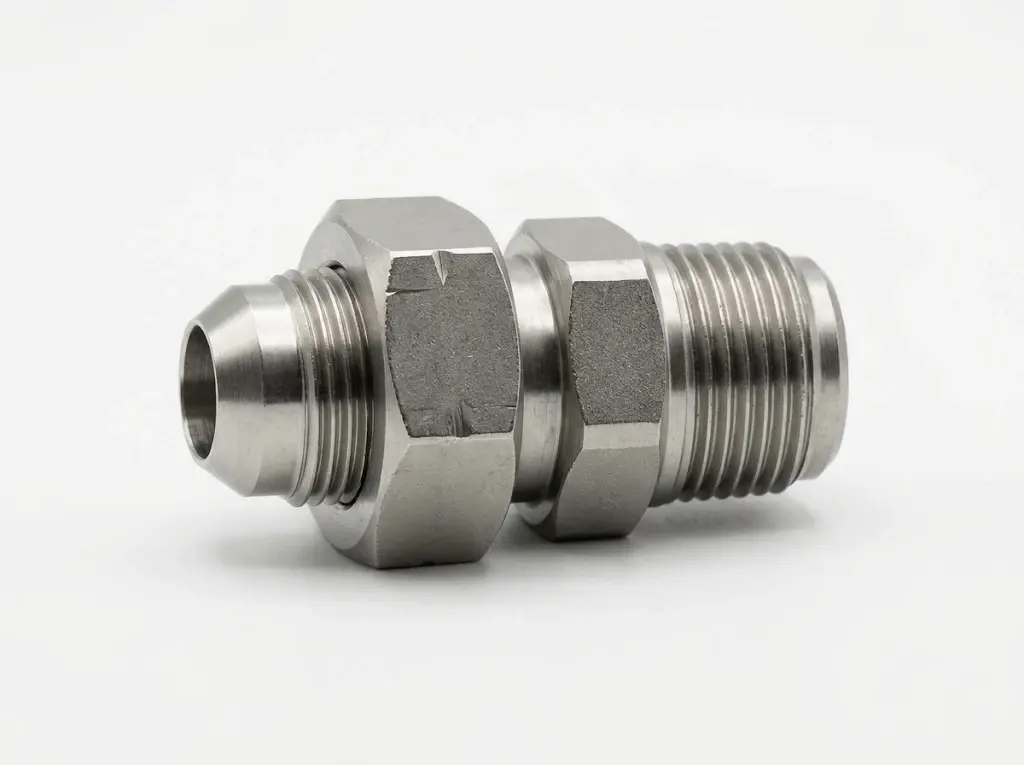
Two fittings sit on the bench. Same bright flare, same thread, and they spin together like they were built as a pair. One is stamped AN and costs a few times what the other does. So what differentiates them, and does the AN vs JIC fittings question actually change what you bolt onto your machine?
We field this one more than almost any other fitting question. Greenshields Industrial Supply has matched 37-degree flare connections at our Everett shop for decades, so we have settled this exact debate for crews and weekend builders. The short version is that these two share a sealing surface and split apart almost everywhere else.
Here is what this guide covers. We start with the flare the two share, then where they split and whether you can run one for the other.
The Flare AN and JIC Fittings Share
Both AN and JIC fittings seal on a 37-degree flare, and that shared angle is the whole reason they thread together and hold.
The seal happens on the cone of the flare, where the flared tube end meets the fitting seat, steel pressing on steel. The threads only pull the two halves tight. A clean flare needs no tape or thread dope to stay dry. Our AN fittings and performance plumbing page breaks down how that flare seats if you want the full picture.
Because the flare angle matches, an AN nut will thread onto a JIC body of the same size and pull up snug. Same in reverse. So, why two names and two price tags? We answer that in the coming sections.
JIC vs AN Fittings, Where the Two Split
The difference has little to do with shape. It comes down to the standard behind the part, and that drives everything from tolerance to price. This sits at the heart of the JIC vs AN fittings question.
JIC is the industrial standard. The letters stand for Joint Industry Council, and the modern spec lives under SAE J514, the rulebook for 37-degree flared fittings in general hydraulic work. You can check the current SAE J514 standard for the details. These are the hydraulic fittings that fill parts bins across the trade.
AN comes from a different world. The letters trace back to Army-Navy, a military and aerospace standard born when a leaking fitting on an aircraft was a life-or-death problem. That history is why AN holds a much tighter standard and machines its parts from aerospace aluminum in that blue or red anodizing. And that pedigree is what you pay for.
Here is the split at a glance.
| Feature | AN fitting | JIC fitting |
|---|---|---|
| Standard | Army-Navy military and aerospace | Joint Industry Council, SAE J514 |
| Flare angle | 37 degrees | 37 degrees |
| Feature | AN fitting | JIC fitting |
|---|---|---|
| Tolerance | Tighter, closely held | Solid but more forgiving |
| Material | Often aerospace aluminum | Mostly steel |
| Traceability | Stricter inspection, documented | Standard industrial grade |
| Cost | Higher | Lower |
| Best for | Performance and aerospace builds | General hydraulics and heavy equipment |
For a given dash size the thread usually matches, which is why an AN and a JIC part interchange on the bench. So the JIC vs AN fittings debate really comes down to how precisely each one is made and what paperwork stands behind it. To see where JIC sits among the wider family of connections, our guide to hydraulic fitting types lays them out side by side.
AN Fittings vs JIC, Can You Run One for the Other?
Here is the question that brings people to the counter. They thread together and seal on the same flare, so can you run one in place of the other? The honest AN fittings vs JIC answer depends on what the joint has to survive.
In a lot of general, low-stakes work, the answer is yes. If the dash size matches, the flare seats, and a JIC body with an AN nut holds fine on a fuel return or a cooler run that is not fighting for its life.
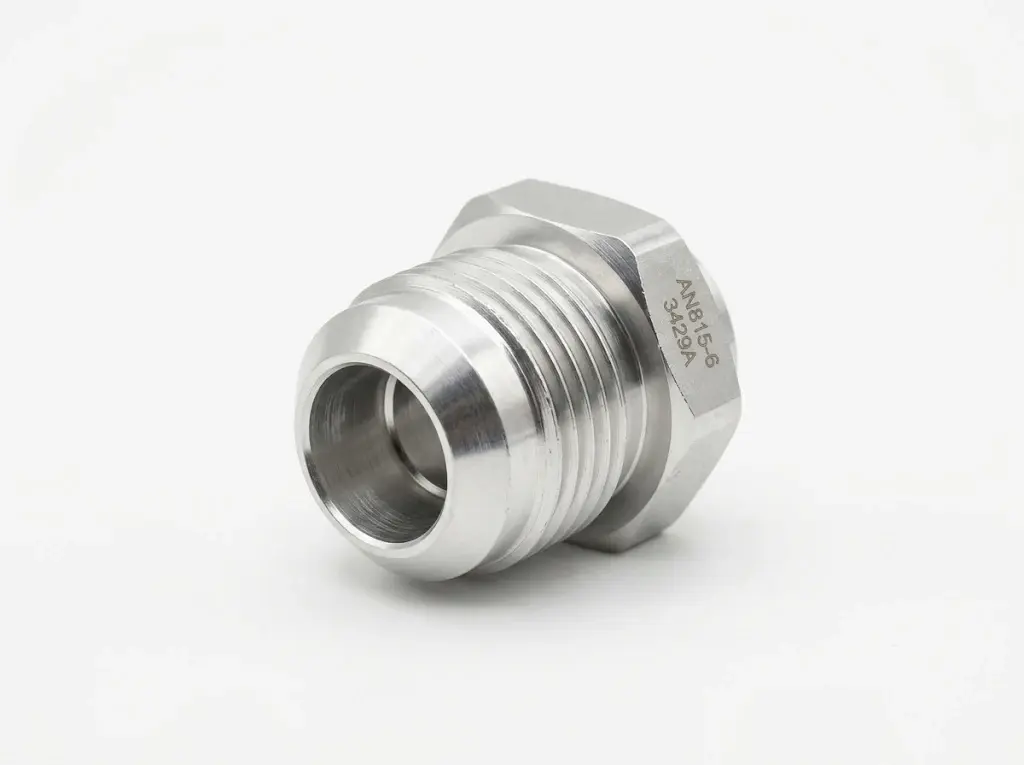
The care starts when the job gets serious. On a high-vibration mount or a safety-critical circuit, that tolerance gap matters, and the same goes for anything built to a manufacturer’s spec sheet. An AN part mated to a JIC part performs only to the looser of the two, so pairing a precision fitting with a rougher one gives back much of what you paid. A JIC fitting also has no place in a certified aerospace or defense build, where AN’s traceability is the whole point.
Two more things earn a look before you mix. Confirm the thread class matches, since not every off-brand part holds to spec. Check that the fitting and the hose behind it both carry a pressure rating, because the flare is only as strong as the weakest piece in the joint. That is the real AN fittings vs JIC decision, and it rides on how hard the job leans on that joint. To bridge either one to another port style, our rundown of hydraulic fittings and adapters covers the pieces that make the jump.